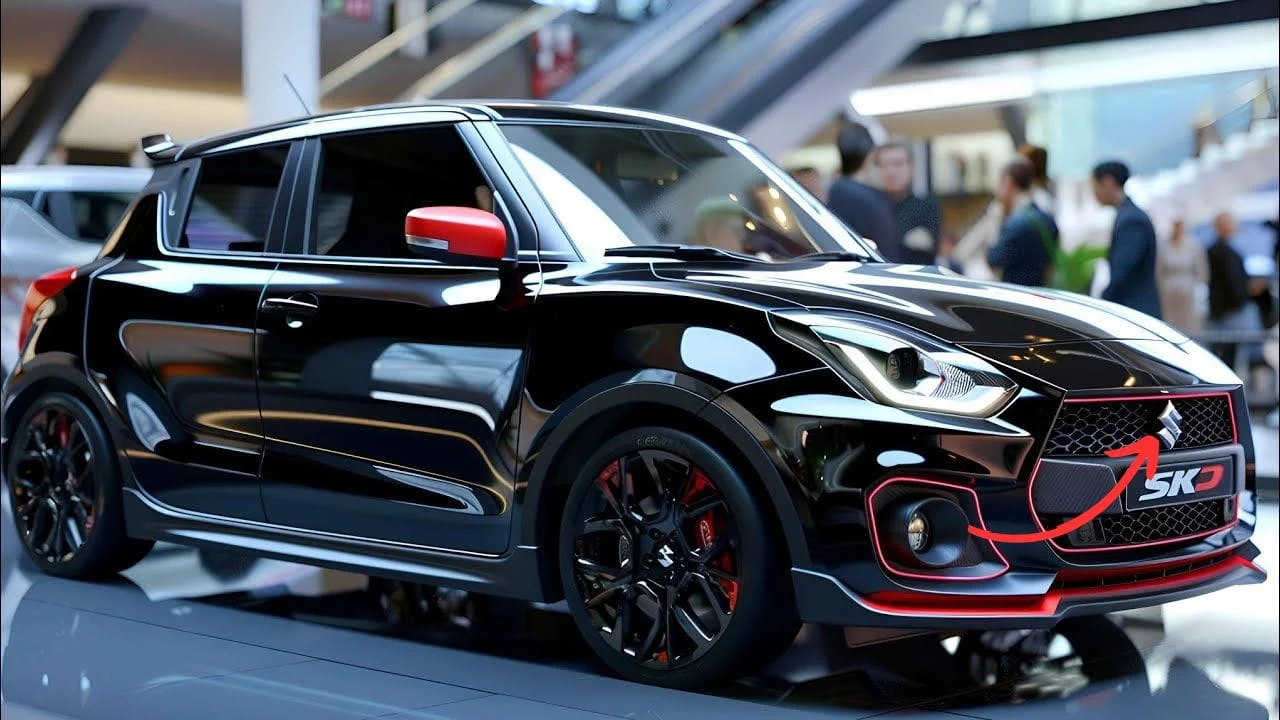

The Maruti Suzuki Swift has always been that “everywhere car” on Indian streets—the kind of hatchback you spot as often as chai stalls at a railway station. But the 2025 update makes the story juicier. Not only does it come with fresher styling and better safety, the recent GST tweak has slashed sticker prices by up to ₹84,600, making it even harder to ignore in the small-car space.
Sporty, Fresh Design
At 3,860 mm long and under 1.7 meters wide, the new Swift is still a tight package, tailor-made for India’s traffic tangles. The stance feels sportier this year thanks to a bolder grille, sleeker LED lamps with DRLs, and that floating roofline that gives it a “hot hatch” vibe without looking too aggressive.
Buyers get six single-tone and three dual-tone color choices, from sober Pearl Arctic White to a bright Sizzling Red. The dual-tone blacks out the roof, which frankly makes the hatch look more premium than its price bracket suggests. Ground clearance is a decent 163 mm, while the weight—just 920 to 960 kilos—means zipping around narrow mohallas or dodging stray rickshaws feels effortless.
Connected Cabin
Step inside, and you’re not greeted by plush leather or fancy sunroofs—but that’s not the Swift’s promise. It’s functional, airy, and surprisingly connected for its class. Five people can squeeze in comfortably, with the flat rear floor making short trips bearable for the middle passenger. The 265-liter boot handles grocery runs or a couple of small suitcases, expandable with 60:40 split seats.

Top trims get a 9-inch touchscreen running wireless Android Auto and Apple CarPlay, plus Arkamys-tuned speakers. The semi-digital instrument cluster shows mileage and trip data clearly. ZXi+ trims even add cruise control and mood lighting, small touches that make highway stints easier. The cabin plastics aren’t plush, but the fit-and-finish feels sturdy—very “daily commuter ready.”
Wallet-Friendly Engine
Under the hood, Maruti’s new 1.2L Z-series petrol engine churns out 82 PS and 112 Nm. Numbers aren’t earth-shattering, but in a sub-1-tonne car, it’s enough to feel sprightly. The 0–100 km/h dash takes around 12 seconds, with a top speed near 160 km/h. For everyday commuting, it feels eager in the lower gears, though enthusiasts might notice the typical three-cylinder buzz when revs climb.
Efficiency is where the Swift flexes. ARAI-certified mileage stands at 24.8 km/l, with real-world figures often in the 20–22 km/l range. That stretches the 37-liter tank to 700–800 km—roughly ₹4–₹5 per kilometer on petrol. And if that’s not frugal enough, Maruti also offers a factory-fitted CNG kit that delivers a staggering 32.85 km/kg.

Safety Basics
A big shift for 2025 is safety. All variants now pack six airbags, ABS with EBD, and ESP as standard. Higher trims offer rear sensors, a 360-degree camera, and hill-hold assist. While it doesn’t go the ADAS route yet, Maruti claims the Swift’s Heartect platform is engineered to meet stricter crash-test norms, keeping it competitive against rivals like the Hyundai i20 or Tata Altroz.
For families, the ISOFIX mounts and improved crash protection are key upgrades. Add in disc-drum brakes tuned for Indian rain-soaked roads, and the Swift’s safety credentials are finally catching up to buyer expectations.
Price Advantage After GST Cut
Here’s where things get interesting. Thanks to the Government’s September 2025 GST revision, the Swift’s prices dropped by as much as ₹84,600. Current ex-showroom Delhi tags now range from ₹5.79 lakh (LXi base) to ₹9.49 lakh (ZXi+ AMT). On-road, that translates to roughly ₹6.5–10.6 lakh depending on variant and city.

Maruti dealers are also sweetening the deal with festive offers: cashback of ₹15,000–25,000, EMI schemes starting at ₹1,200 per month on SBI cards, and freebies like mats or extended warranties. Waiting periods hover around 1–2 weeks, which is relatively short compared to some SUV rivals.
Maruti Swift 2025 Price (Ex-showroom, Delhi)
| Variant | Transmission | Price (₹ lakh) |
|---|---|---|
| LXi | Manual | 5.79 |
| VXi | Manual/AMT | 6.8–7.3 |
| ZXi | Manual/AMT | 8.0–8.5 |
| ZXi+ | Manual/AMT | 8.9–9.49 |
On-Road Buzz
Owners who’ve taken deliveries since May 2024 are largely positive. “It’s a fun zip for peanuts,” says one Delhi youngster, adding that the mileage is a big win for college commutes. A few complaints surface—the lack of a sunroof at this price point, and that AMT gearbox lag that Maruti hasn’t fully ironed out.
Compared to the Hyundai i20, which feels richer inside, or the Altroz, which has a roomier rear, the Swift’s charm is its thrift. You’re buying into reliability, a massive service network, and resale value that still fetches about 75% after three years. For many buyers, that math is too good to ignore.

Quick Specs Recap
| Specification | Details |
|---|---|
| Launch | May 2024 (updated 2025) |
| Engine | 1.2L Z-series petrol, 3-cylinder |
| Power/Torque | 82 PS / 112 Nm |
| Mileage | 24.8 km/l (petrol), 32.85 km/kg (CNG) |
| Transmission | 5MT / 5AMT |
| Price Range | ₹5.79–9.49 lakh (ex-showroom) |
| Safety | 6 airbags, ABS, ESP, ISOFIX |
| Variants | 11 trims |
| Boot Space | 265 liters |
| Warranty | 3 yr / 60,000 km |
Wrap-Up
The Swift 2025 feels like a grown-up version of its younger self. It’s still playful and light on the wallet, but now has safety and tech that today’s buyers demand. With the GST price cut and festive offers in play, Maruti’s evergreen hatchback is once again positioned as the go-to option for city commuters, first-time buyers, and families who want sporty flair without SUV-size bills.
FAQs
Is the 2025 Maruti Suzuki Swift safer than older models?
Yes. Six airbags, ESP, and a stronger Heartect platform make it significantly safer than previous versions.
What is the mileage of the Swift 2025 in real-world driving?
Expect around 20–22 km/l on petrol and about 30–32 km/kg on CNG in mixed conditions.
Does the Swift 2025 offer a sunroof?
No, even the top ZXi+ trim skips a sunroof. It’s one of the few missing features compared to rivals.
What’s the warranty and resale outlook?
Standard coverage is 3 years/60,000 km, with options to extend. Resale is strong, with values often holding 70–75% after three years.
