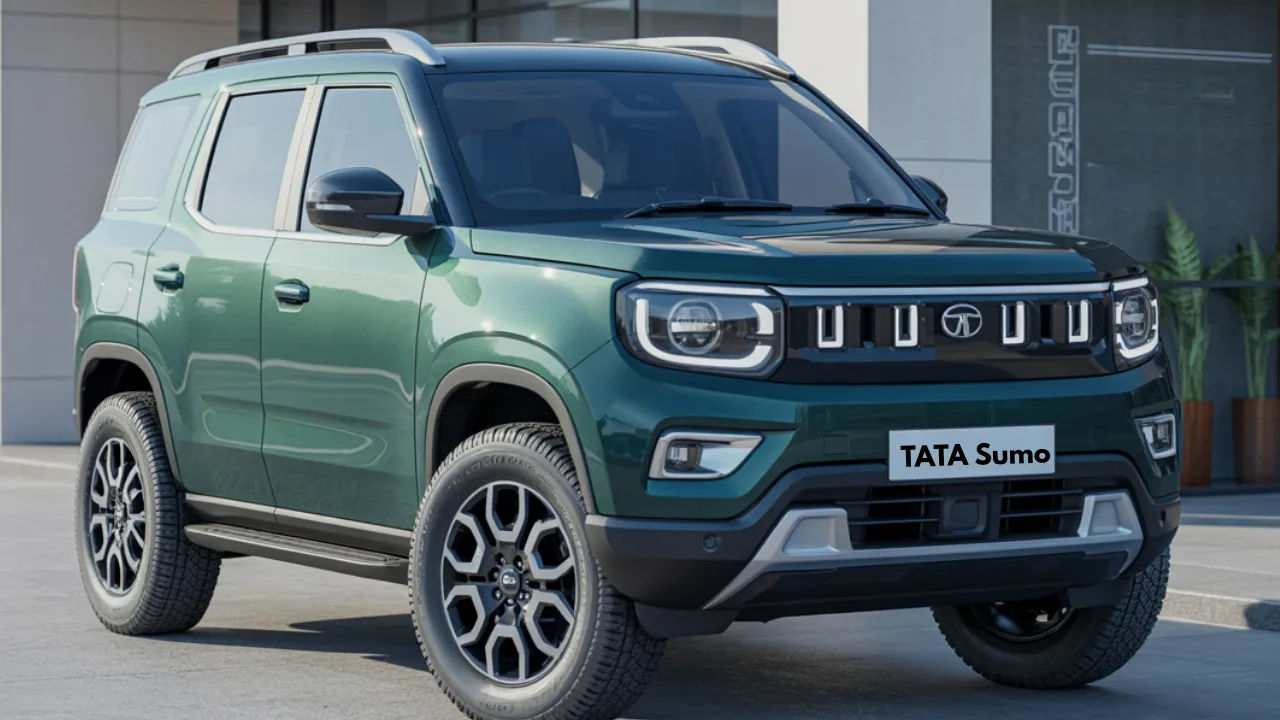

Tata Motors has played a bold card for 2025, and it’s one that taps directly into nostalgia. The Tata Sumo 2025 has been officially revealed, bringing back one of the most iconic names in India’s SUV history. Once a household staple—ferrying joint families, government officers, and even being a favorite among rural transport operators—the Sumo disappeared from the lineup in 2019. Its revival in a new, modernized avatar is set to stir memories while chasing new buyers who want ruggedness with practicality.
Unlike Tata’s current SUV lineup (Punch, Nexon, Harrier, Safari), which leans towards urban sophistication, the Sumo 2025 is unapologetically family-first and utility-driven. The question is: has Tata cracked the formula to blend legacy toughness with modern-day comfort?
Design
The new Sumo doesn’t shy away from its rugged roots. The stance is tall, the grille bold, and the character lines muscular. Ground clearance is generous enough to make Indian potholes and rural roads less of a concern. At the same time, Tata has avoided making it look overly boxy. The edges are smoother, the surfaces more contemporary, ensuring it feels at home in urban traffic as much as it does on a dusty highway stretch.
The SUV doesn’t scream “luxury.” Instead, it communicates solidity. This is a design meant for families that want dependability, not drama.
Interior
Step inside, and the priorities are clear: space and comfort. The Sumo 2025 can seat seven adults, making it a proper people-mover for large families. Seats are ergonomically designed, with thoughtful legroom distribution across rows. Storage compartments are scattered smartly across the cabin for bottles, gadgets, and travel essentials—small touches that matter in daily use.

The materials lean practical rather than premium—easy to clean and durable, so the Sumo can handle everything from kids spilling juice boxes to luggage scraping against panels. Air conditioning has been given special attention, with the promise of effective cooling for the big cabin, which is critical in India’s summer heat.
Powertrain
At its heart is a 2.2-litre diesel engine, a workhorse tuned more for consistency than thrills. It’s expected to deliver enough grunt for city overtakes, highway cruising, and hauling a full load of passengers without complaint.
While Tata hasn’t announced exact figures yet, expect torque-heavy performance rather than high-rev power delivery—perfect for the “fill it up, pack it up, and go” nature of family SUVs. Suspension tuning focuses on stability and comfort, promising to iron out broken tarmac and mild trails alike.
Balancing Economy with Muscle
Fuel efficiency has always been a sticking point for big SUVs, but Tata claims the Sumo 2025’s diesel mill is tuned for frugality without compromising on pulling power. With petrol and diesel prices constantly fluctuating, this makes the Sumo an appealing option for families who want a vehicle that’s large but doesn’t demand constant refueling.

In other words, Tata seems to be offering “the power of an SUV with the running costs of a midsize car”—a balance that could click well in Tier-2 and Tier-3 cities.
Features
Don’t expect cutting-edge gizmos here. The Sumo 2025 isn’t chasing the connected-car crowd like the Harrier or Safari. Instead, it keeps things straightforward:
- A touchscreen infotainment unit with Bluetooth connectivity for calls and music.
- Practical air conditioning designed for the spacious cabin.
- Rugged cabin materials that can handle wear and tear.
This is very much “features you’ll actually use” rather than “features you’ll brag about once and forget.” Tata seems to know its target audience: families, small business owners, and utility-seeking buyers who prioritize dependability over gadgets.
Affordability
Perhaps the strongest card Tata is playing is pricing and financing. With down payments starting at just ₹75,000, the Sumo 2025 is designed to be attainable. EMI structures are expected to be easy on the pocket too, allowing middle-class families and small businesses to consider it seriously.

This pricing strategy is critical, especially since the Sumo will likely compete with Mahindra’s Bolero 2025—another rugged, value-driven SUV that dominates rural and semi-urban markets.
Key Specs (Expected)
| Category | Tata Sumo 2025 (Expected) |
|---|---|
| Engine | 2.2-litre diesel |
| Seating | 7-seater |
| Drivetrain | Rear-wheel drive |
| Suspension | Comfort-tuned for city + mild off-road |
| Features | Touchscreen infotainment, Bluetooth, AC |
| Focus Areas | Durability, family comfort, affordability |
| Down Payment | ₹75,000 (starting) |
Final Thoughts
The Tata Sumo 2025 is not pretending to be something it isn’t. It doesn’t chase luxury or high-end tech. Instead, it doubles down on what made the original Sumo legendary—rugged design, seven-seater practicality, fuel-efficient diesel, and affordability.
In a market that often confuses bigger screens with bigger value, the Sumo offers something refreshingly honest: a no-nonsense family SUV that just works. If Tata can deliver reliability along with attractive pricing, the Sumo’s second innings could be just as memorable as its first.
FAQs
What is the engine in the Tata Sumo 2025?
It is powered by a 2.2-litre diesel engine tuned for torque and efficiency.

How many people can the Tata Sumo 2025 seat?
The SUV offers seating for seven passengers.
What features does the new Sumo offer?
It comes with a touchscreen infotainment system, Bluetooth connectivity, and efficient AC for the cabin.
How much does the Tata Sumo 2025 cost?
Exact prices aren’t out yet, but Tata is pitching affordability with down payments starting at ₹75,000.
Who is the Tata Sumo 2025’s main competitor?
Its biggest rival will be the upcoming Mahindra Bolero 2025 in the rugged, affordable SUV segment.
